

Grand Junction | Community GHG Inventory

Lotus developed Grand Junction’s 2018 and 2021 community GHG inventories; developed a business-as-usual forecast through 2040; completed a carbon sequestration analysis of the City’s urban forest and parklands; developed a dashboard to display the results of the emissions inventories; entered the emissions inventory data into ClearPath and CDP; and researched relevant resilience and climate adaptation metrics for the city to consider tracking. Additionally, Lotus synthesized the results of all deliverables into a final report while simultaneously providing high-level policy recommendations for the primary GHG sectors to help reduce emissions.
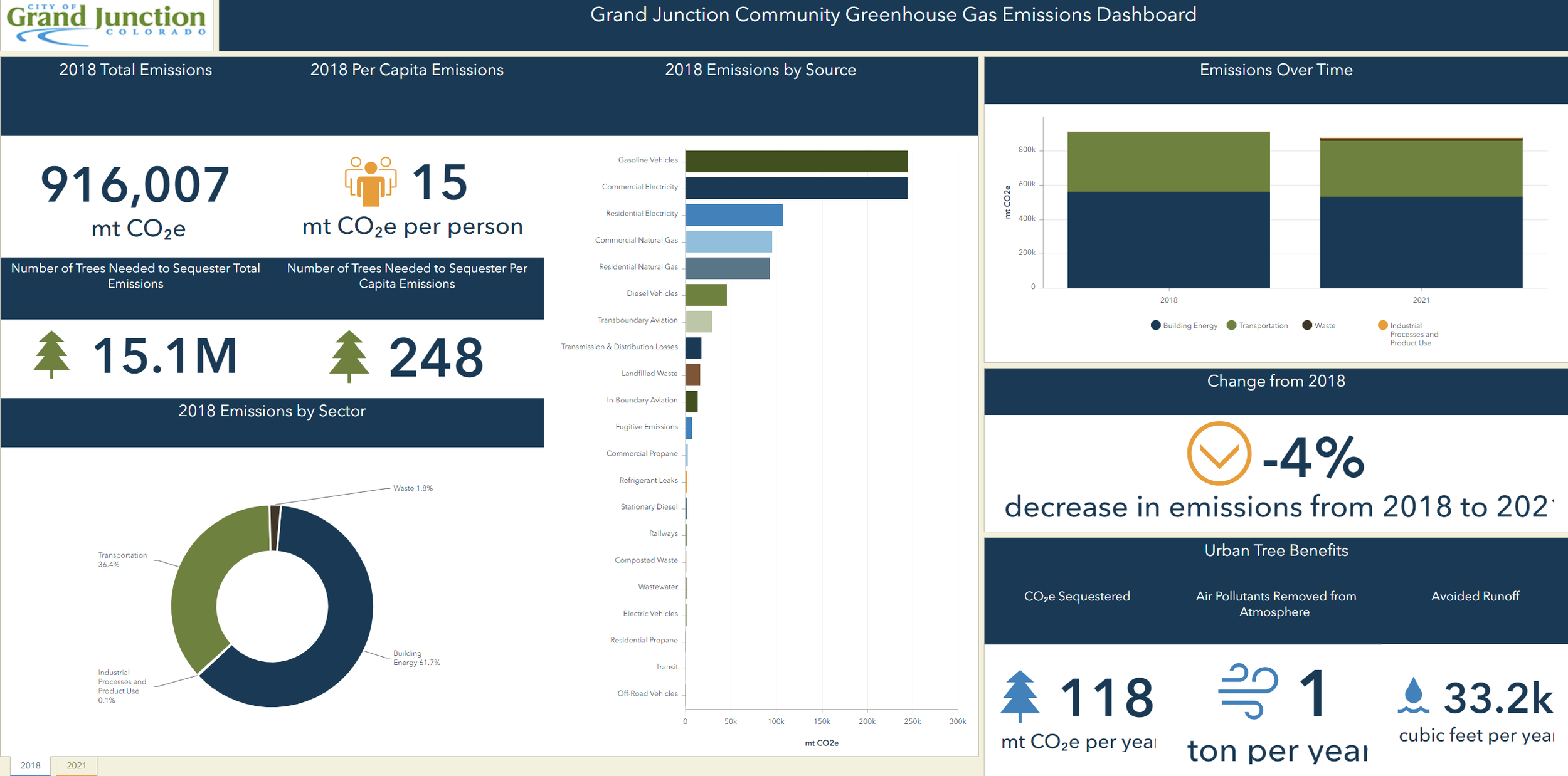
“We are so grateful to Lotus for creating a simple, easy to use, well-documented inventory spreadsheet. We wouldn’t be able to do any of the work we do without it!”

Holy Cross Energy | Greenhouse Gas Inventory

Holy Cross Electric Association, Inc. (HCE) has a vision to lead the responsible transition to a clean energy future for their 43,000 plus members. In 2018, HCE set a goal/target to provide 70 percent clean energy by 2030 (Seventy70Thirty) and reduce greenhouse gas emissions associated with their power supply by 70 percent based on 2014 levels. To accurately measure and report these targets, Lotus was hired to complete a 2018 greenhouse gas inventory and review power supply chain inventories for 2005, 2014, and 2018. The inventory is utilizing the Climate Registry’s General Reporting Protocol and Electric Power Sector Protocol.
“We had the good fortune of working with Hillary and the Lotus Engineering team to assemble Holy Cross Energy’s Greenhouse Gas Inventory. They were a pleasure to work with through the process and their expertise was indispensable. They helped us iron out difficult questions related to which emissions reporting standards to follow, how best to collect and organize our data, and how to account for every last emission related to our organization that is meaningful enough to track. Once our inventory was complete, we not only had a solidified baseline for our previous years emissions but also a inventory tool that is easily updated by our internal staff for future years. We would absolutely hire Lotus again the next time we need GHG related consulting support.”

Kamehameha Schools | GHG Inventory and Carbon Stock Assessment

Kamehameha Schools (KS) is a Native Hawaiian educational trust and is one of the largest organizations in Hawaiʻi. KS operates an educational system that includes preschools, three K-12 campuses, community education, and scholarships across the Hawaiian Islands. In addition, KS is the largest private landowner in the State, stewarding 10% of Hawaiʻi’s land-base with a major stake in native forestry. Lotus, in partnership with Sustainable Pacific, conducted a greenhouse gas inventory and carbon stock assessment for KS. Guided by this data, the Consultant Team provided carbon reduction recommendations as well as a carbon stock and sequestration opportunities analysis.

Maui County | Climate Action and Resilience Plan
Lotus developed Maui County’s Climate Action and Resiliency Plan in partnership with Sustainable Pacific, and Geos Institute . The plan included four greenhouse gas inventories (two municipal inventories and two community inventories) that informed how to achieve their goal of zero emissions and a carbon-neutral economy by 2045. Community and stakeholder engagement was central to the project. The project was heavily focused on engaging community voices and integrating Hawaiian cultural values. Our team worked with staff from the County and community leaders to create strategies that would have an impact on the climate and align with indigenous ways of knowing. Key parts of the plan are translated into ʻŌlelo Hawaiʻi so that all may understand the importance of the goals and the role community members play to achieve them. The climate change mitigation strategies addressed in the plan focused on municipal operations, building energy, transportation, waste, land use (including agriculture and natural resources), and public education and outreach. The plan also presented resilience strategies by integrating the concepts of self-sufficiency, nature-based solutions, resilient infrastructure, and strategic relocation. This 18-month project demonstrates our expertise in equitable community engagement, technical knowledge, and clear communication of a multi-dimensional project.

New Mexico State University | GHG Emissions Inventory

Lotus completed the first greenhouse gas emissions analysis for New Mexico State University's (NMSU) main campus in Las Cruces for the 2018-2019 school year. This inventory included several scope 3 emissions sources, including employee commuting, business travel, waste, and wastewater treatment. The 2019 fiscal year inventory covered all sources of emissions generated on campus, including through the cogeneration systems within the campus facilities. NMSU was also interested in understanding what the campus' emissions were in the 2005 fiscal year. To analyze this, Lotus collected historic data from the university on energy use, campus population, and changes in buildings over the year to estimate emissions back to the 2005 fiscal year. Based on the data, NMSU has significantly reduced its emissions since 2005. The 2019 inventory and 2005 backcast put NMSU on a path of identifying the major sources of emissions and developing programs and policies to help reduce those emissions over the coming years.

Pierce County, WA | GHG Inventory

Lotus developed 2015 and 2019 municipal operations GHG inventories for Pierce County, Washington. Lotus analyzed building level data and estimated emission factors for several utilities from which the County receives electricity. Additionally, Lotus created an inventory management plan (IMP) documenting all data sources and methods used in the inventory. The IMP also included instructions for updating inventories enabling Pierce County to develop their own inventories in the future.
“Lotus conducted Pierce County’s operational greenhouse gas emissions inventory. Their level of knowledge and expertise made the process straightforward and painless, analyzing diverse datasets and distilling complex calculations into sharable narratives. Frequent communication, quick turnarounds, and the team’s positivity made it an overall great experience.”

Pitkin County, CO | Embodied Carbon Analysis

Lotus conducted data analysis for Pitkin County and the Roaring Fork Valley, in partnership with Brightline Group, to estimate residential climate emissions and embodied carbon from the construction and home management sectors. This data was to guide local policy development. Using a data-storytelling process, Lotus detailed the impacts from the construction and home management economies on the region’s greenhouse gas emissions.
Key findings from the Embodied Carbon Analysis can be found HERE

Routt County and City of Steamboat Springs | GHG Emissions Inventoryj, Climate Action Plan, Comprehensive Plan

GHG Emissions inventory and climate action plan
Lotus has been hired twice by Routt County (with the support of Steamboat Springs) to complete sustainability projects. In 2019, Lotus worked with Routt County and Steamboat Springs to complete a 2018 GHG emissions inventory that was GPC-compliant. Lotus performed all data collection and analysis, developed a City- and County-specific emissions reporting tool, backcasted (until 2005) and forecasted (until 2050) emissions, developed an inventory management tool, and wrote an inventory summary report.
In 2020/2021, Lotus led the development of Routt County’s Climate and Adaptation Action Plan which included leading an informed stakeholder engagement process considering equity, modeling the impact of emission reduction strategies, and developing an aspirational yet achievable Climate Action Plan for the County and each municipality located within the community. Lotus also helped design a public-facing website to assist with community engagement.
You can track the progress in implementing the plan HERE.
In 2025 the Yampa Valley Sustainability Council contracted Lotus to perform an update to the Routt County community-wide greenhouse gas emissions inventory originally created for 2018. The inventory includes a breakout for the City of Steamboat Springs as well as the unincorporated portions of the county. Lotus also provided analysis into trends between inventory years and key drivers of emissions increases and decreases. Updates were also made to the 2018 inventory based on newly found data and methodology updates. A presentation to the YVSC board was also given at the end of the project.

Steamboat Springs Comprehensive Plan
Additionally, Lotus is a subconsultant to the SE Group to create a Comprehensive Plan for Steamboat Springs. Couched in a number of recently updated plans, including a Routt County Sustainability plan developed by Lotus (2021), Steamboat Springs is looking to improve sustainability and resiliency within the unique mountain town. Core to their way of life is recreation and subsequently tourism, but all of this puts weight on the city’s most precious resources - the Yampa River, the Steamboat Springs Ski Area to name a few. The Comprehensive Plan will be instructive in outlining the Steamboat approach to responsibly managing assets, protecting the thriving outdoor life that folks travel all over the world to experience, improving traffic and walkability, all while keeping an eye to increasing frequency of wildfire and drought.

Summit County, CO | Climate Action Plan & Climate Equity Plan
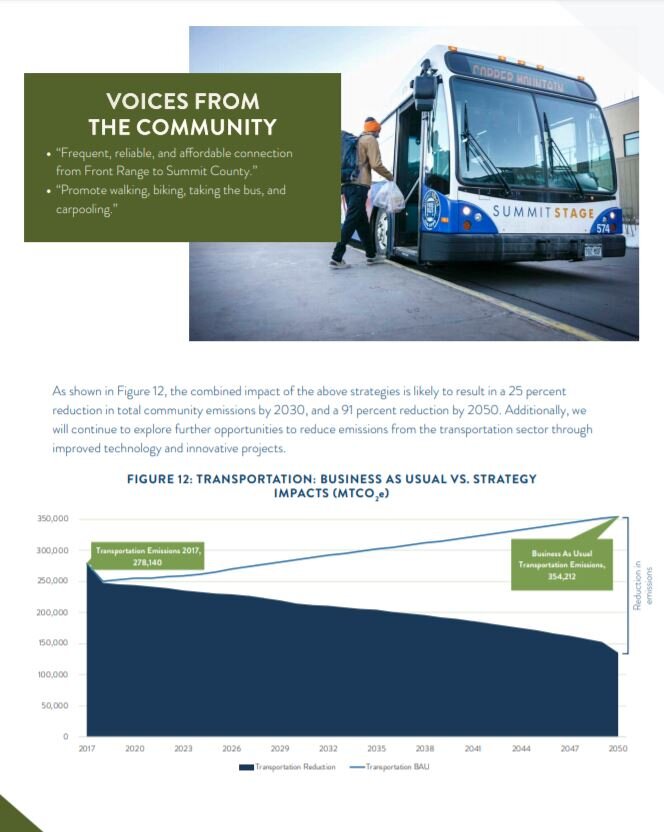
The jurisdictions, municipalities, ski areas, and institutions in Summit County, convened by High Country Conservation Center (HC3), contracted with Lotus to create a Climate Action Plan for the community. Lotus guided and supported the entire development process, which included conducting Summit County’s first GHG emissions inventory. Lotus facilitated and led the stakeholder engagement process that informed the development of Summit County’s Climate Action Plan in collaboration with the High Country Conservation Center. Our team convened meetings of stakeholders and experts, provided education and background on climate change, and facilitated conversations to develop strategies that will reduce emissions and achieve the goals of the Climate Action Plan for this mountain community. The development process also included modeling the impacts of stakeholder-selected strategies to determine emissions reductions, energy use, and other benefits; forecasting a business-as-usual case scenario; and providing the community with a final Climate Action Plan that defines aspirational targets for climate mitigation and resiliency and establishes a path towards achieving these goals.
Lotus ultimately developed a Comprehensive GHG Inventory and an aspirational yet achievable Climate Action Plan for the County.
Since completing the County’s Climate Action Plan, the jurisdictions in Summit County embarked on implementation work. Lotus worked with the High Country Conservation Center to update the County’s GHG inventory with 2021 data and develop a Climate Equity Plan that specifically details projects and programs to enhance equity in the community through the implementation of climate action work. Lotus facilitated an equity steering committee that included representatives from local community-based organizations, local governments, and agencies serving disproportionately impacted communities in Summit County. The Steering Committee advised on the development of a tri-lingual public survey, listening sessions, and informational interviews to guide the development of climate equity strategies that will supplement the existing climate action work. During the implementation of this work, HC3 will continue to work with Steering Committee members through the strong relationships that were built in this process to ensure that climate equity strategies meet their intended goals in supporting benefits for all Summit County residents.
Below is a presentation on Summit County’s Climate Equity Plan from Mountain Towns 2030.
“Lotus’ expertise was instrumental in developing our community’s climate action goals and understanding what it will take to meet them. Their depth of knowledge and nimble facilitation skills were a tremendous asset to our planning process.”

Town of Erie | Sustainability Master Plan and Community-wide GHG Inventory

Lotus worked with the Town of Erie to create the Town’s first Sustainability Master Plan. The process included in-depth research; informational interviews with staff, community members, and partner agencies; a series of advisory board meetings; stakeholder workshops; and community outreach at community events and a project open house. The result was an actionable plan for strategies that the Town and its partners can implement over the coming five years to enhance sustainability as the community grows. This Plan will serve as a decision-making tool and includes information on potential funding sources, partners, and actions that the Town can pursue in the areas of energy, recycling, transportation, and education and outreach.
Since completing the Town’s Sustainability Master Plan Lotus has also supported work on behalf of the Town to obtain grant funds for charging stations, support community engagement efforts related to waste diversion policy, and is embarking on completing the Town’s first GHG emissions inventory.
In 2022, Lotus developed the Town of Erie’s first-ever 2020 community GHG inventory and 2020 municipal GHG inventory. Lotus synthesized the results of the community and municipal inventories into a report as well as a dashboard to visually communicate the results of the inventories. Lotus also created inventory management plans for the two inventories, trained the Erie team on how to update the inventories in future years, and presented the results in person to the Town’s Sustainability Board.
“Julia Newman, Senior Associate at Lotus Engineering and Sustainability has led the Town of Erie Colorado’s effort to develop a community-focused Master Sustainability Plan. Community input along with the Town Administration and the Sustainability Advisory Board was critical in this process. Julia was masterful in her ability to facilitate a diverse group of people and opinions in public forums along with small teams sessions. Our success was due to Julia’s attention to detail and ability to help all contributors feel heard and understood.”

Town of Mountain Village | GHG Emissions Inventory and Climate Action Plan

Lotus worked with the Town of Mountain Village to complete a 2019 greenhouse gas emissions inventory and the Town’s first-ever Climate Action Plan! This effort was necessary in order to understand the specific emissions sources and impacts that the Town could influence, as well as modeling the status-quo emission projections over the coming years. The resulting Climate Action Plan (CAP) for Mountain Village presents the framework for achieving significant emissions reductions in the community between 2020 and 2050. Lotus then developed Mountain Village’s 2020 community GHG inventory and 2020 municipal GHG inventory. Additionally, Lotus modeled the impact of various current and proposed incentive programs on GHG emissions through 2030.
2020 Community GHG inventory Results Summary, Community and Municipal GHG Emissions Inventory Results Memos.

Urban Land Conservancy | Implementation Plan

In early 2021, Lotus had the opportunity to work on a small project with the Urban Land Conservancy (ULC), a nonprofit development organization that focuses on projects that benefit the whole community, such as affordable housing and below-market commercial space for nonprofits. We met with a core team from ULC to help them to define their goals and next steps for embedding sustainability into their operation.
Building off of these new goals, Lotus is now helping ULC develop an implementation plan for the sustainability goals and strategies defined in January 2021. Lotus is developing green leasing language and policies, internal office sustainability practices, a sustainability scoring rubric for RFPs, tenant energy use education toolkit, and sustainability language and procedures for a material and vendor procurement policy. Lotus is excited to continue working with ULC to grow its sustainability policies and procedures.

Xero Shoes | GHG Inventory

Xero Shoes creates a variety of shoe styles that embody the natural feeling of running barefoot. As part of the Recreational Equipment, Inc (REI) Product Standards Climate and Environmental Stewardship Valuation, Xero Shoes has committed to measuring its carbon footprint and reducing its carbon emissions in alignment with the recommendations of the United Nations (UN) and the Intergovernmental Panel on Climate Change (IPCC). To help Xero Shoes accomplish this, Lotus completed the company’s 2021 and 2022 operational greenhouse gas inventories, the results of which were shared with REI. Lotus identified all potential GHG emission sources from operations and supply chains and obtained the necessary data to develop the inventory. In completing both inventories, Lotus followed REI’s requirements using the GHG Protocol and including emissions from scopes 1, 2, and 3. For the 2022 inventory, Lotus helped Xero Shoes translate the energy-use data from their secondary office in Prague, Czech Republic, as well as evaluate the emissions from the addition of a new, larger warehouse in Denver. Lotus also created inventory management plans for both inventories.
“Hillary and her team at Lotus have been phenomenal to work with. They are always on or ahead of deadlines, professional, and do a great job of making GHG data easy to digest. As a brand that was measuring its footprint for the first time and is looking to measure it annually moving forward, we really appreciate Lotus’ open-door policy for any questions we had or will have in the future. We highly recommend Lotus to any company that is looking to measure its emissions and make a meaningful change.”